El Corte Inglés meets its Zero Waste road map with all its centres certified in Spain and Portugal
POSTED ON
Sustainability and social compromise
- The company has achieved Zero Waste certification at 100% of its department stores, logistics platforms, Supercor, Sanchez Romero and Outlet establishments in Spain and Portugal, consolidating its circular economy model.
- In 2025 alone, El Corte Inglés has recovered over 100,000 tonnes of waste, avoiding more than 61,000 tonnes of CO2e emissions.
- This feat has made it possible to recover materials and generate new resources from waste, with an equivalent result of avoiding the felling of more than 430,000 trees.
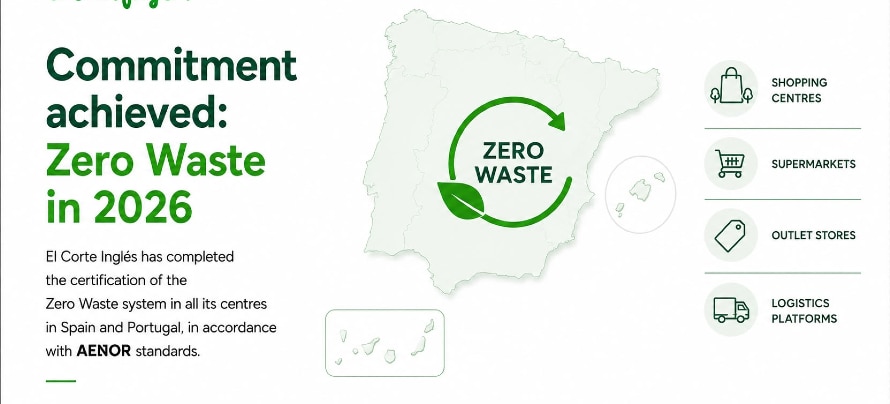
El Corte Inglés has reached the target set in its 2026 road map by ensuring that 100% of its department stores have the AENOR Zero Waste certification, adding all Supercor, Sanchez Romero and Outlet establishments, as well as its logistics platforms in Spain and Portugal. The company thus consolidates its advanced waste management model and commitment to the circular economy.
In total, more than 300 establishments and platforms were certified in 2025, allowing for the recovery of more than 100,000 tonnes of waste, over 94% of the total managed. All this has contributed to preventing more than 61,000 tonnes of CO₂e emissions.
The Zero Waste Management system is based on the principle that all waste produced, managed and everything that is managed, is recovered, closing the circular economy cycle and surpassing the threshold of 90% recovery required to obtain this certification.
El Corte Inglés began Zero Waste certification in 2019 at its shopping centres and logistics platforms in Galicia. Since then, the system has been implemented progressively in the rest of the autonomous regions and in Portugal. Following the pilot experience, a first phase of the project began, covering from 2020 to 2023, to extend certification to all shopping centres and logistics platforms. It was then implemented at small establishments, including outlets, Supercor and Sanchez Romero.
Tangible results
El Corte Inglés activity generates more than 50 different fractions of waste from its daily operation and customers' homes, all of which are correctly separated for recovery.
During 2025, this contributed to major circular economy achievements including:
- Paper and cardboard: equivalent to conserving more than 430,000 trees.
- Plastics: corresponding to the manufacture over 630 million small water bottles and avoiding the consumption of over 21 million litres of oil.
- Organic waste: over 2,400 tonnes of compost are made or over one million m3 of biogas.
- WEEE (Waste Electrical and Electronic Equipment): over 900 tonnes of raw materials prepared for reuse and the rest recovered into different plastic and metal materials, which has enabled the recovery of almost 2,000 tonnes of materials and critical elements such as cobalt, magnesium, antimony, strontium, etc.
Added to these are measures such as optimisation of logistics routes and vehicle loading, which have led to an additional reduction in CO₂ emissions, as well as agreements with entities to avoid food waste with donations.
A living system in continuous improvement
El Corte Inglés Zero Waste Management System exceeds internal and external audits every year and is based on a self-control model that facilitates the detection and correction of incidents, allowing for continuous improvement.
This milestone has been possible thanks to the involvement and commitment of professionals from the company, who have adapted procedures and processes to ensure correct waste separation, management and recovery. All certified establishments receive specific training and support from a network of environmental officers in each region and Zero Waste managers at each centre, who ensure the correct functioning of the system.
The company will continue maintaining and reinforcing this certification at all its centres, progressively incorporating new establishments and adapting the system to regulatory and operational changes, in order to continue moving towards increasingly efficient and sustainable resource management.